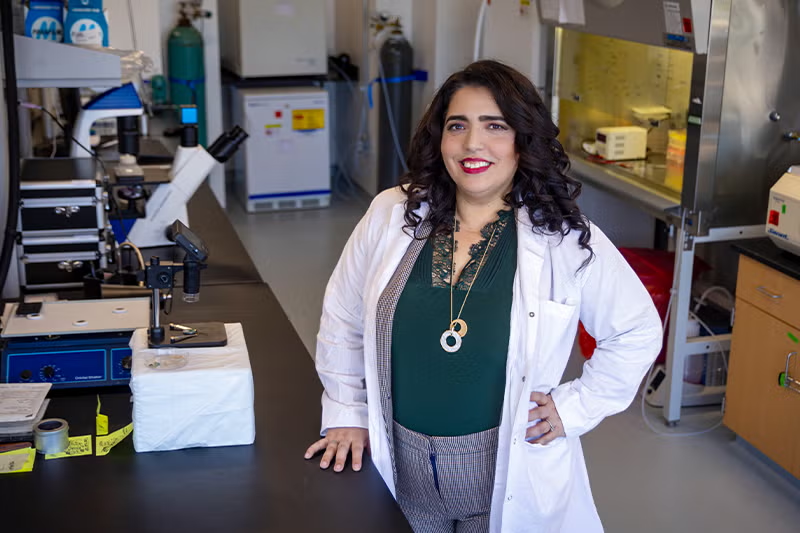
Carolina’s Ronit Freeman to lead project to stop ‘undruggable’ diseases
UNC-Chapel Hill will lead a consortium receiving up to $24.8 million to detect and stop some of the world’s most devastating diseases, including Alzheimer’s and pulmonary fibrosis at their earliest molecular stage, years before symptoms appear.
Funded through the Advanced Research Projects Agency for Health, an agency within the U.S. Department of Health and Human Services, the project will bring together seven universities and industry partner Siemens Healthineers to study the earliest molecular changes associated with protein-misfolding diseases.
The project, called Instruct & Modulate Protein Ensembles for Disease Evasion, or IMPEDE, aims to develop an early-detection biomarker for Alzheimer’s disease, advance preclinical treatments for Alzheimer’s and pulmonary fibrosis, and create tools that could be applied to other protein-misfolding diseases.
Stephen J. Klawa, Michelle Lee, Kyle D. Riker, Tengyue Jian, Qunzhao Wang, Yuan Gao, Margaret L. Daly, Shreeya Bhonge, W. Seth Childers, Toluope O. Omosun, Anil K. Mehta, David G. Lynn, Ronit Freeman